Nov 2026
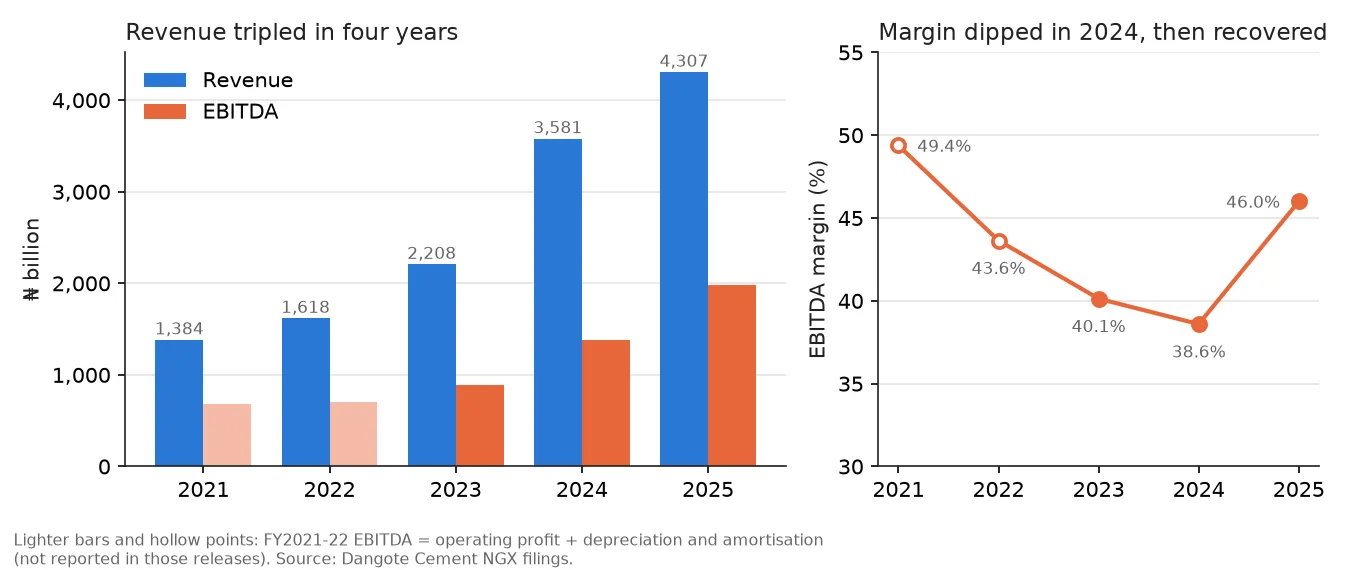
An equity research note on Dangote Cement built from NGX filings: a DCF puts fair value at ₦871 against ₦1,490, a price that implies naira bond yields of 12.6%.
Equity research, Valuation, Nigeria, Python
New to some of the terms? See the glossary at the end.
This autumn I built a bot to trade memecoins: brand-new tokens that launch by the thousand every day, mostly on hype, and mostly die within hours. The original idea was the one everyone has. Find new tokens that look safe, buy, sell at 2x.
That idea failed in the first simulation. What came after is the interesting part: a month of recording every new token forward, pre-registering every rule before testing it, killing candidates that looked brilliant, and a week of real-money trading that lost 92% per trade while the same strategy made money on paper, on the same tokens, at the same moments.
This is a private project and a strategy is still running, so I won’t say what the surviving rule does. Everything else is here: the method, the dead ends, and the post-mortem.
The obvious move is to download price histories and backtest. For memecoins, that gives you a lie. Free data sources quietly drop tokens that rugged or were delisted, so every rule you test only ever meets the survivors. Any “buy new tokens” strategy looks great on data where the dead ones have been removed.
So the first thing I built was a recorder that runs forward:
The aggregator feed I started with missed about half of all new pools at busy times: it ran around six minutes late, out of order, and rate-limited. I added an on-chain listener that watches pool-creation transactions directly, tested against real saved transactions. The recorder has since run for weeks finding well over a thousand new pools an hour.
Before the first simulation I wrote down when to stop: if, after filters, fewer than about 35% of entries reach 2x, or the average trade loses money after realistic slippage, fees, token taxes and failed sales, the project ends.
The simulator charged for all of that: a 0.5% fee and 1% slippage per side, the price impact of the trade on the pool’s actual reserves, and each token’s own taxes. Data was split by time, first 60% to choose settings and last 40% to test them, never randomly.
With about a day of recorded data and 1,728 rule settings per market segment:
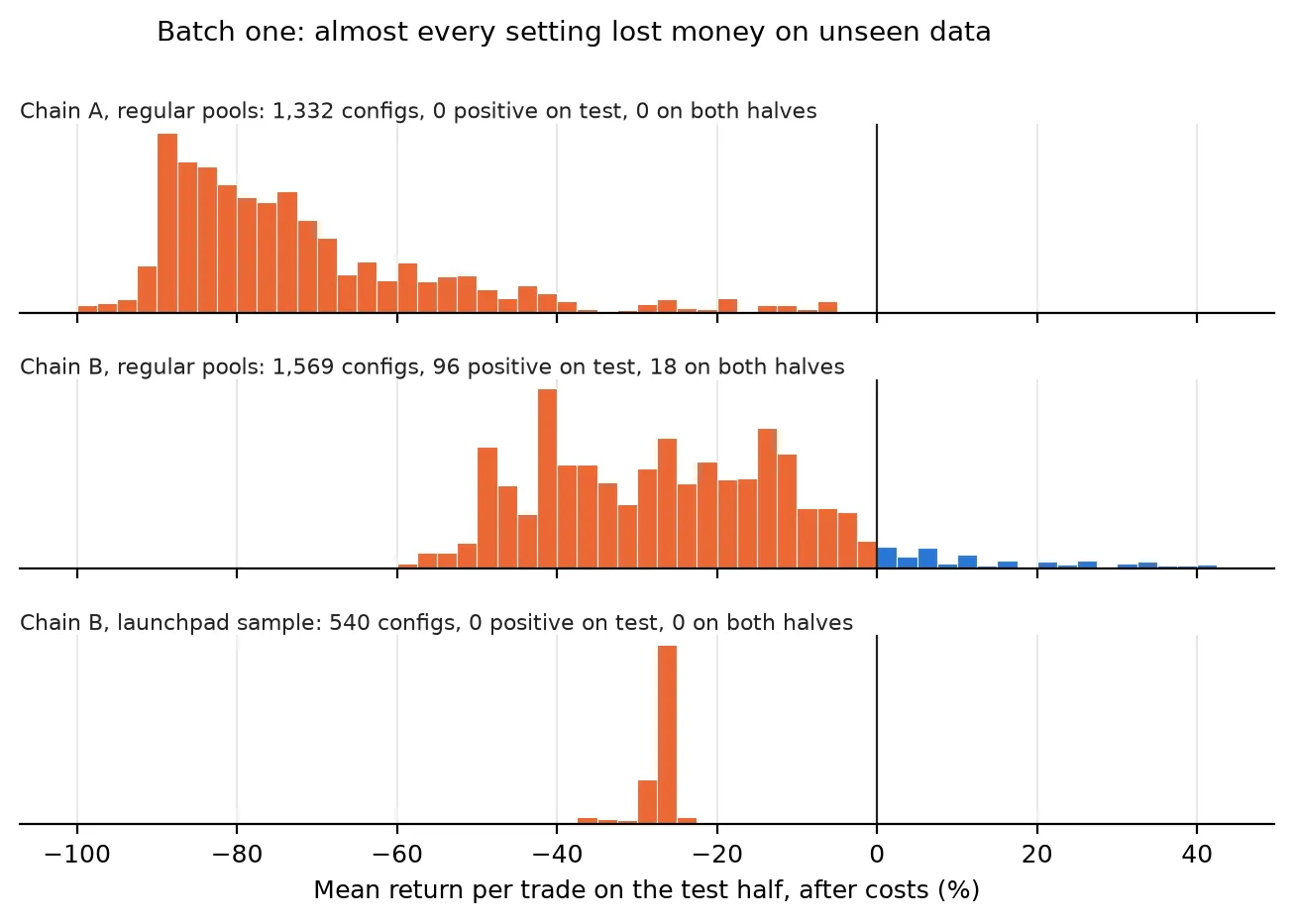
A small cluster of settings in one segment did make money on both halves. They were best-of-1,728, every confidence interval included zero, and I said so in the log: leads, not edges. I locked two of them as candidates C1 and C2, with a pass mark for data recorded after the lock: at least 100 trades, a positive mean, and a 95% confidence interval whose lower bound is above −5%. No retuning. A changed rule is a new candidate with its own clock.
A second batch of ideas produced a third candidate, C3. By then the simulator also assumed every fill happened one snapshot after the signal, because these tokens swing 30% to 50% in a minute. Several close neighbours of C3 died under that assumption; only the exact rule survived, so only that rule was locked. It was best-of-224 and the batch had been designed after seeing the first one, so it got the same treatment.
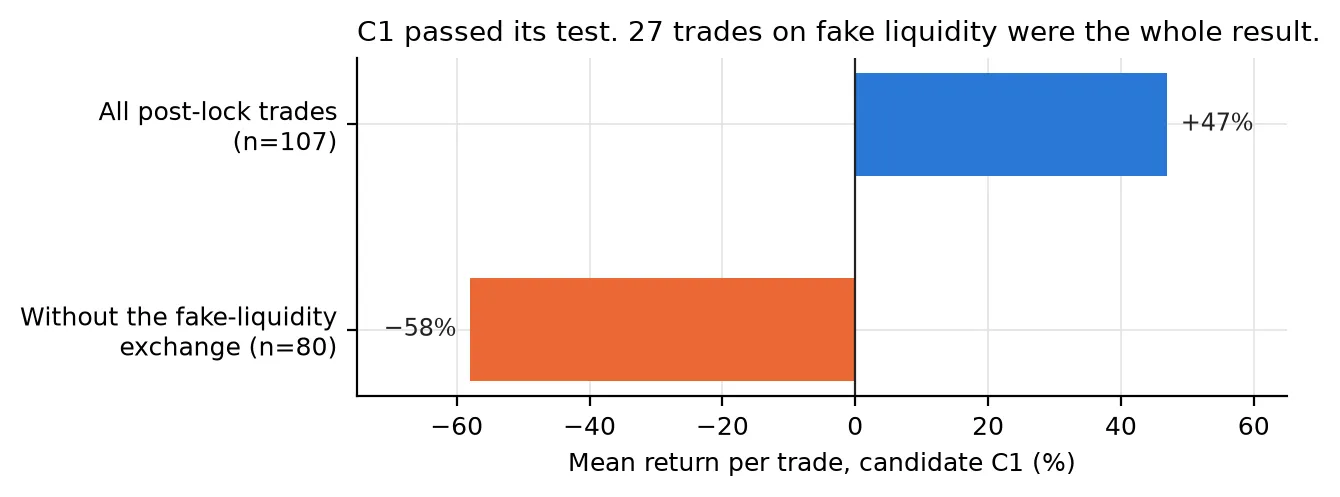
A day later, C1 passed its test mechanically: 107 post-lock trades, +47% per trade, a confidence interval comfortably above zero.
It was fake. All of its profit came from 27 trades on one small exchange, and those pools’ reported liquidity was invented. One pool shown at $1.46 million held 98.7 SOL, about $12,000. The memecoin side of the pool was being valued at a manipulated price, so the “liquidity” was mostly the token pricing itself. Without that exchange, C1 was 80 trades at −58% per trade, median −99%.
Checking further, about 10% of new pools on that chain reported at least five times their real liquidity in their first ten minutes, on major exchanges too. The fix was in the data, not the rule: from then on the recorder stored the real reserve on the money side of each pool, and the simulator priced fills and liquidity filters off that.
C2 failed its pass mark honestly. C3 passed, having shrunk by more than half from its pre-lock number, which is what best-of-many picks do.
C3 moved to paper trading: real signals, quotes from the exchange’s live reserves, re-quoted three seconds later to model block inclusion, minus taxes, an extra margin for slippage and front-running, and real gas. Exits were managed on live sell quotes.
The gap between simulator and paper started at 9 points per trade at about 100 trades. At about 1,900 trades it was down to 2 points, with the same outcome on 85% of tokens. That was the first time I trusted the simulator.
Paper trading has one blind spot that matters a lot in this market: a paper sale can’t fail. Honeypots are tokens you can buy but not sell. Paper books them as wins. When the live bot later hit two of them, paper had booked both as take-profit wins.
So before every entry, both paper and live now simulate the full buy, approve and sell against the chain. If the simulated sale reverts, the bot doesn’t buy, and paper doesn’t record a trade either. A paper loss the bot could never have taken would distort the results in the opposite direction.
Of the simulated C3 trades, about a quarter were rugs. So instead of a new signal I built a veto: a model that scores a trade C3 already wants, using only data from the first minutes of the token’s life, and skips the riskiest ones.
The spec went into the log before any model was fitted:
Both passed on the simulation. Then both models were frozen and scored every live paper signal in record-only mode, without changing a single trade, for a paired comparison on the same trades:
| Model | AUROC (95% CI) | Rugs removed | Winners kept | Verdict |
|---|---|---|---|---|
| Logistic regression | 0.683 (0.655–0.711) | 28.9% | 91.9% | Killed |
| Gradient boosting | 0.779 (0.753–0.806) | 43.8% | 95.1% | Passed |
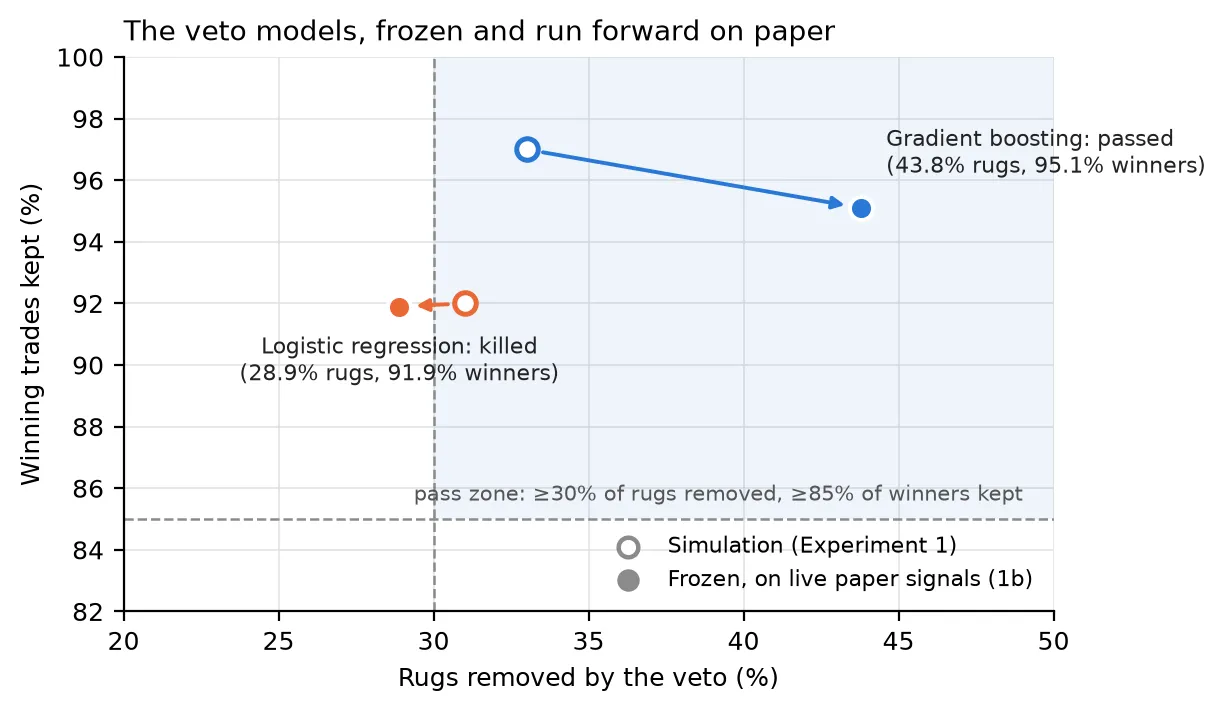
The logistic regression improved the average trade and was still killed, for missing the 30% bar by 1.1 points. That’s what pre-registration is for. If I’d been allowed to argue with my own criteria, I would have.
From 6 to 12 October the bot traded real money on a tiny wallet. It closed 24 trades and lost 92.3% per trade on average, with one winner. Two more positions could never be sold. The wallet went from $52.62 to $10.16. Over the same days, paper trading the same rule made money.
The tempting conclusion is “paper is fiction”. I took the post-mortem slowly, trade by trade, against the paper account and the recorder’s snapshots.
Execution was fine. Tokens received were within −3.8% to +1.4% of the quote taken just before the buy. Signal to buy took 7 to 23 seconds.
Our buys didn’t cause the rugs. On 21 of the 23 rugged tokens, paper had bought the same token within 12 seconds of the live buy, sent no transaction at all, and still booked the same −100%, 6 to 21 seconds after entry. Liquidity was there 10 to 20 seconds before entry and zero at the next snapshot. The creators drained those pools at the moment the signal fired.
The safety stops picked the worst possible moments. Scam creators rug in bursts, and rugs from the same burst are correlated, not independent. On a $10 to $50 wallet, the $2.50 minimum trade was 5% to 25% of equity, so two to four rugs in a row tripped the daily loss limit. The bot was then locked out for the rest of the day, which was exactly when the strategy earned its money. Over that week, paper took 412 trades the live bot was blocked from by the daily limit or my own manual pause. Those trades were comfortably profitable. Between my pauses and redeploys, the bot was started 55 times.
| Day | Paper, while live was trading | Paper, after live was locked out |
|---|---|---|
| 6 Oct | 8 trades, −41% | 59 trades, positive |
| 7 Oct | 4 trades, −100% | 85 trades, positive |
| 8 Oct | 4 trades, −100% | 144 trades, positive |
| 9 Oct | 3 trades, −100% | 111 trades, positive |
A replay of the stop rules on paper trades confirmed it. Run continuously at 5% sizing, none of the daily stops ever fired. The rug-burst cooldown skipped trades that earned the same as every other trade, so it reduced growth without reducing risk. The stops didn’t protect the wallet. They confined it to the bursts.
The truly live-specific loss was honeypots: 2 of 26 trades. That rate, if it holds, is a large enough haircut on every winning trade that it has to be measured with real money. Paper can’t.
On 12 October, before the post-mortem, I diagnosed the losses as our real buys springing rugs on very young pools. The fix was a variant that waited longer before entering. In dry-run it lost 11.2% per trade over 22 positions, against a backtest that had promised a healthy profit. The bootstrap put the chance of a result that bad, if the backtest were right, at under 1%.
On the same 22 tokens, the original timing made money on paper. The variant entered a median 826 seconds later and found a new way to lose: almost a quarter of its entries never bounced and drifted down until the four-hour time limit, against 2% for the original. The post-mortem then showed paper had caught the same rugs at the same pool ages, so the diagnosis behind the variant was wrong. I retired it.
The veto model told the same story from another angle. On the variant’s signals it scored only 2 of 268 above its cutoff, and the bot’s existing filters had already skipped both. It had nothing to add there, so I stopped that experiment without a verdict rather than wait two months for one.
The next step is a new real-money canary, under a rule I locked on 28 October, before its first trade:
Its first job isn’t to make money. It’s to measure the two things paper can’t: whether real take-profit sells fill (by late October only one had, close to paper’s price for the same token), and the real honeypot rate.
The recorder, simulator, paper traders and live bot are Python, running as one service with a persistent database on Railway, with tests that replay real saved chain transactions. The live bot simulates every buy and sell on-chain before sending it, holds a capped amount, sweeps profits to a separate wallet whose key isn’t on the server, and never refills itself. A Next.js dashboard on Vercel shows live, paper and dry-run books side by side, a chart for each trade, a rug analysis page, and a pause switch and wallet transfers behind a PIN.
None of that was the hard part. The hard part was not believing my own numbers.